
AAT Level 4 – NEW L4PAT
27 May 2026 2026-08-06 9:51AAT Level 4 – NEW L4PAT
AAT Level 4 Diploma in Professional Accounting (L4PAT)
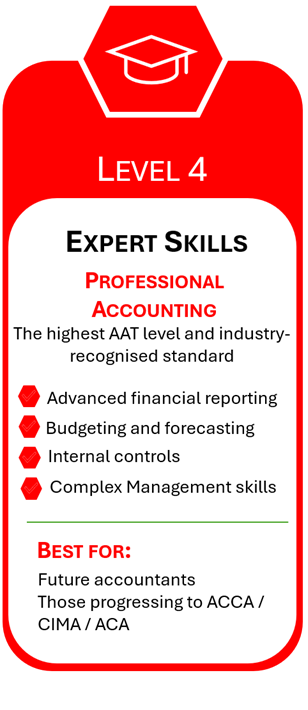
From September 2026, AAT will introduce a new Level 4 qualification, replacing the current Q2022 Diploma. The new programme will be known as the Level 4 Diploma for Professional Accounting Technicians (L4PAT).
Under the new structure, all units will be compulsory, with no optional unit pathway. Areas such as tax, audit, and business awareness will form part of the core curriculum for every learner. A new subject area, Advanced Business Awareness, has also been introduced, covering topics such as data analysis, sustainability, ethical practice, and strategic business understanding.
Assessment will be fully computer-based and automatically marked, with results typically available within 24 hours. Remote invigilation will also be available from the start of the qualification.
The updated qualification has been approved as a Higher Technical Qualification (HTQ) in England, recognising that it meets current employer and industry requirements. This approval also means eligible learners may be able to access funding through the Lifelong Learning Entitlement (LLE), supporting greater accessibility for adult learners and career changers.
Students currently studying the Q2022 qualification will be able to continue until 31 July 2028. Transitional arrangements will also be available to support progression onto the new syllabus where appropriate.

Duration: 12-24 months
Start: Sept 26
Fees: 2590
(inclusive of exams*)
* additional registration fee applicable
* exams to be held at our Hanley centre
* fees subject to change
What are the key changes to AAT Level 4?
he new Level 4 structure represents a significant change in how the qualification is delivered. Under the current Q2022 syllabus, learners can select optional units. From the introduction of L4PAT, this is no longer the case, as all units become compulsory, creating a single, standardised learning pathway for every student.
The qualification is now made up of five core units:
Financial Accounting (FNAC)
This unit focuses on preparing financial statements for limited companies, applying international accounting standards, and interpreting financial performance using ratio analysis. It replaces the previous DAIF unit and accounts for 25% of the overall assessment.
Management Accounting (MNAC)
Covers budgeting, cost control, financial planning, and cash management to support business decision-making. This unit replaces AMAC and incorporates elements of CSFT, also contributing 25% to the overall grade.
Audit and Internal Controls (ATIC)
This unit combines internal control systems and audit principles into one integrated module. It explores fraud prevention, governance, risk management, and the full audit process. It is worth 15% of the qualification.
Principles of Taxation (PTAX)
Brings together personal and business taxation into a single unit covering income tax, National Insurance, Capital Gains Tax, and Corporation Tax. This unit contributes 15% of the final grade.
Advanced Business Awareness (AVBA)
A new unit designed to reflect modern business practice, covering topics such as business strategy, data use, sustainability, communication, and professional ethics. It accounts for 20% of the overall assessment.
By streamlining content and removing optional pathways, the updated qualification ensures all learners develop a consistent and well-rounded skill set. Key professional areas such as taxation, audit, and business awareness are now embedded into every student’s learning experience.
How will the exams work?
All assessments within the new qualification will be fully computer-marked, marking a clear change from the Q2022 structure, which included longer written response tasks. Under the updated format, results are typically released within 24 hours following completion of AAT’s standard quality assurance checks.
Despite the change in assessment style, the level of challenge remains the same. Learners will still be required to demonstrate strong understanding, apply knowledge to real-life scenarios, and interpret financial and business information effectively. Assessments are developed by subject specialists, trialled before release, and subject to ongoing quality control to ensure consistency and reliability.
The pass mark remains set at 70% for each unit, with overall achievement graded as Pass, Merit, or Distinction.
In addition, assessments will be available through both traditional exam centres and remote invigilation from the outset, offering greater flexibility for learners who prefer to complete assessments from home.
Six Core Themes
The L4PAT qualification is designed around six core themes that reflect the changing demands of the accounting profession and the broader business environment.
Sustainability
Learners will explore how organisations can adopt responsible practices and align with modern reporting expectations, supporting long-term environmental and commercial goals.
Ethical Practice
This theme develops the ability to apply professional judgement, manage ethical dilemmas, and maintain integrity in line with industry standards.
Digital Skills and Innovation
Focuses on the use of digital systems and data tools to analyse information, improve processes, and support informed decision-making.
Communication
Emphasises clear and effective professional communication, including collaboration, reporting, and presenting financial information to different audiences.
Regulatory Awareness
Covers key areas such as audit principles, fraud prevention, compliance, and wider financial regulation, ensuring learners understand professional requirements.
Equity, Diversity, Inclusion and Belonging (EDIB)
Promotes awareness of inclusive workplace practices and the importance of equality and respect within professional environments.
These themes are embedded throughout the qualification rather than delivered as separate modules, ensuring learning is applied, relevant, and directly connected to real workplace practice.
Timetable
| COURSE TITLE | START DATE | Days / times | Study methods |
| Week commencing | Class options | ||
| Management Accounting (MNAC) | 08/09/2027 TBC | Tues 17:30 – 20:30 Weds 09:30 – 12.30 Thur 13:30 – 16:30 | Apprenticeship Commercial (paid) Self study (plus) per unit or full qual |
| Financial Accounting (FNAC) | 02/03/2028 TBC | ||
| Audit and Internal Controls (ATIC) | 14/09/2026 | ||
| Principles of Taxation (PTAX) | 04/01/2027 | ||
| Advanced Business Awareness (AVBA) | 19/04/2027 |
Course Options
There are no formal entry requirements for this course. However, it is strongly recommended that learners have successfully completed the AAT Level 3 Diploma in Accounting, as this provides the essential knowledge and skills needed to progress to Level 4 study.
A good standard of English and Maths is also advised, ideally at GCSE Grade 4 or equivalent, to support understanding of the more advanced technical content and assessment requirements at this level.
If English is not your first language, please get in touch to discuss whether additional learning support may be available.
Where learners have not completed AAT Level 3, they may be asked to complete a short skills assessment or take part in an informal discussion. This helps us understand your current level of experience and ensures you are guided onto the most appropriate study route.
Please also note that individuals who have been declared bankrupt or who have a criminal record may not be eligible for AAT membership, which could impact examination eligibility. In such cases, we recommend contacting AAT directly for further advice and guidance.
Transition from Q2022 to L4PAT
Learners currently registered on the Q2022 Level 4 Diploma may continue their studies and sit assessments until 31 July 2028. In many cases, completing the current qualification may still be the most straightforward and cost-effective option.
For those who are unable to complete Q2022 within this timeframe, AAT has introduced transition arrangements to support progression onto the new L4PAT qualification. Certain completed units may be transferred across and mapped to the updated syllabus. For example, DAIF may transfer to FNAC, and AMAC may transfer to MNAC. Where units have been combined in the new structure, such as INAC and AUDT forming ATIC, results may be carried across as an average of prior achievement.
A small transfer fee is payable to AAT for this process, and learners will be required to complete at least one assessment within the L4PAT qualification in order to be awarded the new certificate. In cases where only part of a combined unit has been achieved, additional top-up assessments may be available to support progression.
Please note that results achieved under the AQ2016 framework cannot be transferred to L4PAT. Where applicable, learners are advised to complete Q2022 within the transition period to ensure full recognition of prior achievement.
The qualification is now made up of five mandatory core units:
Financial Accounting (FNAC)
This unit focuses on preparing financial statements for limited companies, applying international accounting standards, and interpreting financial performance using ratio analysis. It replaces the previous DAIF unit and accounts for 25% of the overall assessment.
Management Accounting (MNAC)
Covers budgeting, cost control, financial planning, and cash management to support business decision-making. This unit replaces AMAC and incorporates elements of CSFT, also contributing 25% to the overall grade.
Audit and Internal Controls (ATIC)
This unit combines internal control systems and audit principles into one integrated module. It explores fraud prevention, governance, risk management, and the full audit process. It is worth 15% of the qualification.
Principles of Taxation (PTAX)
Brings together personal and business taxation into a single unit covering income tax, National Insurance, Capital Gains Tax, and Corporation Tax. This unit contributes 15% of the final grade.
Advanced Business Awareness (AVBA)
A new unit designed to reflect modern business practice, covering topics such as business strategy, data use, sustainability, communication, and professional ethics. It accounts for 20% of the overall assessment.
Mandatory Units
The qualification is now made up of five core units:
Financial Accounting (FNAC)
Management Accounting (MNAC)
Audit and Internal Controls (ATIC)
Principles of Taxation (PTAX)
Advanced Business Awareness (AVBA)
Choose the learning style that best fits your goals, lifestyle, and preferred way of studying. Whether you want complete independence, flexible support, or a classroom environment, we have an option to suit you.
Self Study
Learn at your own pace with complete flexibility and full control over your studies.
- Study whenever and wherever it suits you
- Access all course materials online
- Ideal for independent and self-motivated learners
- Progress through the course at a speed that works for you
Self Study Plus (On Demand Learning)
A flexible study option that combines independent learning with the reassurance of support when you need it.
- Start your course at any time
- Learn independently using structured, easy-to-follow materials
- Access tutor support whenever you need extra guidance
- Perfect for learners who want flexibility with added confidence and support
Classroom Delivery (face to face or on-line)
A structured, interactive learning experience delivered face-to-face or online by experienced tutors.
- Learn in a supportive classroom environment
- Receive direct guidance from qualified tutors
- Study alongside other learners for added motivation
- Ideal for those who prefer routine, structure, and live teaching
Extensive resources area available to students based on their booking type
Your package includes:
✔ Study text & exam kit
✔ Access to our own Online learning portal (as applicable)
✔ In-house mock exams
✔ Personal tutor available via email and telephone
✔ Exam fees included
✔ All admin fees to sit exams at our approved Hanley Training Centre
✔ No hidden costs. No surprises.
All assessments within the new qualification will be fully computer-marked, marking a clear change from the Q2022 structure, which included longer written response tasks. Under the updated format, results are typically released within 24 hours following completion of AAT’s standard quality assurance checks.
Assessment is based on AAT competency standards. To pass, learners must achieve a minimum score of 70% in all computer-based assessments.
We are a registered AAT assessment centre and deliver exams at our dedicated centre for both internal and external candidates. Internal students can book via their tutor, while external candidates can book through the online booking form – Exam Centre
All costs are included in the pricing structure at ATA.
Course fees include tuition, student support resources, and examination fees at our Hanley branch. To secure your place, a 25% course deposit is required. Interest-free payment plans are also available. Please contact us for further details.
Additional membership fees applicable: £258
What next?
Enrol now to secure your place. Once you have registered your interest, a member of our team will be in touch to confirm the next available intake date. We run monthly intakes, so you won’t have to wait long to begin your studies.
After enrolment, we will provide you with the enrolment form and all the necessary information to get you started. If you have any questions before booking, please contact us for more details.


